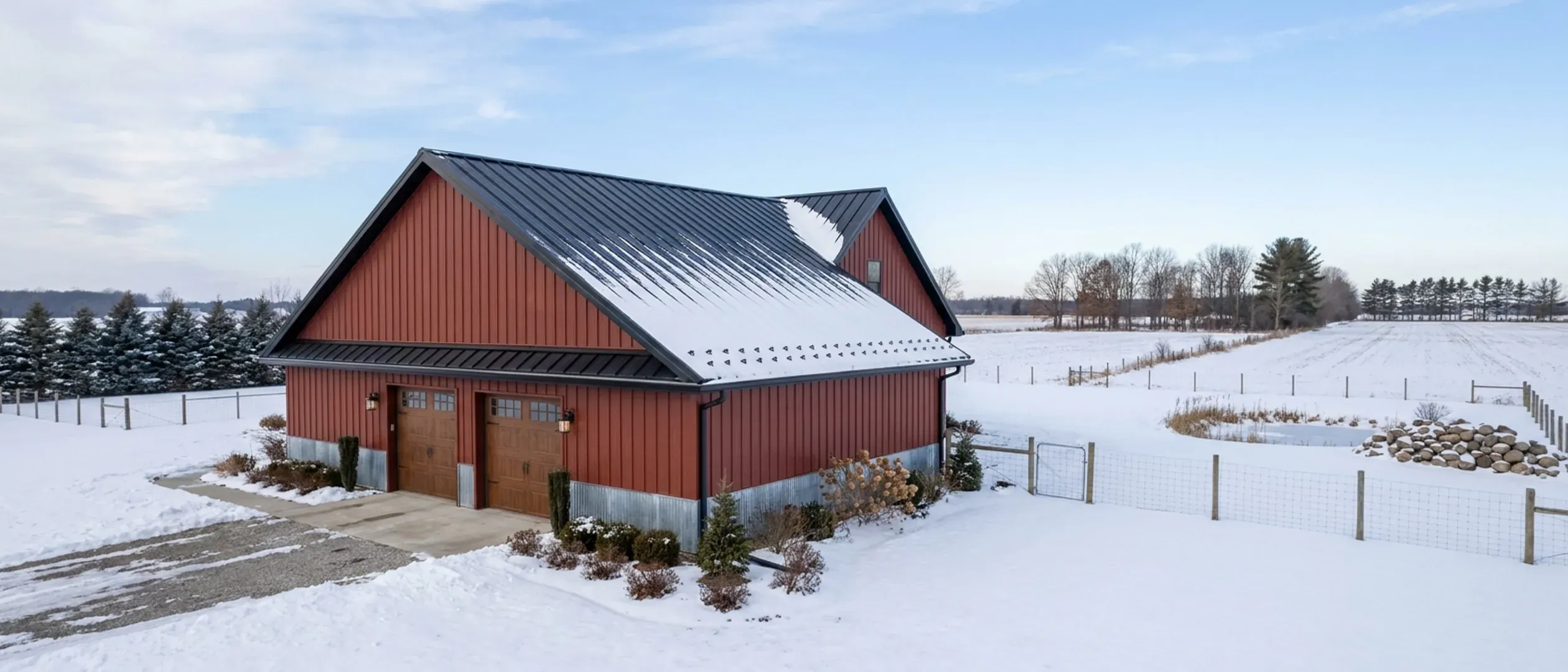
Are Barndominiums Worth It in Michigan?
Whether a barndominium is worth it depends on what you need the building to do, where the land is, and how long you plan to stay. In Michigan the answer has a particular shape. The land comes first: the township, city or village zoning decides what can be built, and on rural land without sewer or public water, the soil and the well decide it too. Then come the questions about value: how an appraiser values a barndominium on rural acreage with few comparable sales, how an insurer rates an unusual building far from a fire hydrant, and what a long heating season costs a building with large walls and roofs. This page sets out when a barndominium usually is worth it, when it usually is not, and what to check before deciding. It publishes no prices of its own. For costs, see the cost guide, which cites its sources.
Figures on this page are cited third-party or government data, not a quote from Michigan Barndominium Builders.
Bottom Line Up Front
- A barndominium is usually worth it when you need a shop or equipment space anyway, have or can buy land whose zoning allows the house you want, and plan to stay long enough that resale matters less than how the building works for you.
- The Michigan-specific cautions are rural appraisals with few comparable sales, insurance rated partly on construction type and distance from a fire hydrant, and a heating season long enough to make insulation and air sealing part of the value, not an extra.
- Check the land first: zoning in writing, the septic answer from the county or district health department, and an insurance quote and lender conversation on the actual design, before any money goes into the building.
When a barndominium is usually worth it
These are the situations where the building type earns its place.
You need the shop anyway
If you would otherwise build a separate pole barn or garage for vehicles, a boat, equipment or a business, putting it under the same roof as the house uses one foundation, one roof and one set of utilities. Michigan winters make a heated, attached workspace more useful than in milder places.
The land allows it
When the zoning district allows the house and the shop you want, and the soil and water answer is known, the biggest uncertainties are gone before you commit.
You want an open plan that can change
A clear-span frame lets interior walls move later. For households that expect to change how they use the space, that flexibility is part of the value.
You are staying a long time
The longer you stay, the more the value comes from how the building works for you and the less from what a future buyer or appraiser thinks of it.
When it usually is not
These are the situations where a conventional house, or a different site, may serve better.
The zoning does not clearly allow it
If the district limits accessory building size, requires a minimum house size, or has design rules that a metal building does not meet, a variance or rezoning is a separate process with no guaranteed outcome.
You may sell within a few years
Where comparable barndominium sales are few, the buyer pool can be narrower and the appraisal less predictable. A short hold makes both matter more.
The loan depends on a high appraisal
If the financing only works with the appraisal at or above the cost, a thin rural market is a risk. Talk to a lender that has financed barndominiums, and read the financing guide.
The shop is bigger than the house needs
An oversized shop may add little appraised value, and very large farm-type buildings can raise the question of whether the property is residential at all.
What to check before deciding
Each of these can be answered before any money goes into the building.
The zoning, in writing
Ask the township, city or village zoning office what the district allows for a house and an attached or detached shop on the parcel, and get the answer in writing.
The septic and well answer
Ask the county or district health department what its soil evaluation and septic permit process involves for the parcel, and where a well could go. A site that needs an engineered septic system changes the budget and the layout.
An insurance quote on the actual design
Give an insurer the construction type, the distance to the nearest fire hydrant and fire station, and the shop use, and get a quote before the design is final.
A lender that has financed one
Ask how the lender's appraisers handle barndominiums and rural comparables, and what the lender requires during construction.
The site's design figures
Michigan's residential code sets the ground snow load by county, and in places by township or city, and a 42-inch minimum footing depth that the building official may adjust. Both shape the frame, the doors and the foundation, so find out what applies to the parcel before ordering a kit.
Reading this because you are weighing a build? The next step is a plan drawn for your program.
What's different about Michigan
The land decides first
A barndominium is a house, and it is only worth building where the zoning allows it. In rural Michigan the zoning authority is usually the township, and districts differ on lot size, setbacks and rules for large accessory buildings. The legal guide explains who decides and what to ask.
Farmland and property tax rules travel with the land
If the land is enrolled in a PA 116 farmland agreement, MCL 324.36104 allows new structures only for farm use, including a residence for someone essential to the farm, or with local and state approval, so check before you buy. Next to an established farm, Michigan's Right to Farm Act generally protects normal farm operations that follow accepted practices from nuisance claims. On tax, a principal residence is exempt from the school operating tax once the owner claims it (MCL 211.7cc). Taxable value normally rises each year by the lesser of 5 percent or the rate of inflation, plus additions such as new construction, and it resets to the state equalized value the year after a sale (MCL 211.27a).
Materials carry sales or use tax
Michigan's use tax is 6 percent (MCL 205.93), and the Use Tax Act treats a person building or improving someone else's real estate as the consumer of the materials they install (MCL 205.92). A kit or a set of materials is not tax-free because it becomes part of a house.
Appraisal on acreage
Fannie Mae's Selling Guide says rural locations may lack recent truly comparable sales, and lets the appraiser use older or more distant sales if the report explains why. Properties that are unique for their neighborhood need special consideration. An atypical outbuilding may be given little or no contributory value, and significant barns or storage buildings can prompt the lender to confirm that the property is residential rather than agricultural. A barndominium on acreage can appraise well, but the value rests on the evidence the appraiser can find nearby.
Insurance is priced on the building and the site
The Department of Insurance and Financial Services says Michigan law does not require homeowners insurance, but a lender financing the home will likely require it. Insurers may rate homes on factors including the type of house, its age and condition, safety devices and distance from a fire hydrant, and weather such as heavy winds, tornadoes and heavy snow drives claims. DIFS also says almost everyone in Michigan is eligible for coverage under the law, and that every company writing homeowners insurance must insure an eligible applicant.
Winter sets the running costs
NOAA's 1991 to 2020 normals put Michigan's annual heating load at about 6,070 heating degree days at Detroit Metro Airport, 6,410 at Grand Rapids, 7,100 at Traverse City and 9,220 at the Marquette weather station. A barndominium's tall walls and large roof make the insulation and air sealing the biggest influence on what it costs to live in. The EPA's moisture-control guidance adds that in cold weather condensation forms on the inside of walls and roofs at insulation gaps and cold framing, which in a steel building is a durability question as well as a comfort one.
Rural land carries its own projects
Off the sewer and water mains, a septic system and a well are part of the house: the county or district health department issues the septic permit under its own sanitary code, and a state-registered contractor drills the well. A driveway, grading and utility connections are part of the site. MCL 460.725 requires a MISS DIG notice at least 72 hours before each excavation. None of this is unique to barndominiums, but on acreage it can be a large share of the project.
Pros and cons, honestly
Pros
- One building covers the house and the shop, garage or equipment space.
- A heated attached workspace is especially useful through a Michigan winter.
- A clear-span interior can be rearranged later.
- The shell can be closed in quickly.
- Worth most to owners who plan to stay a long time.
Cons
- Rural appraisals may lack comparable sales.
- A large shop may add little appraised value.
- Long heating seasons make the envelope a large part of running costs.
- Zoning rules on accessory buildings and house design vary by township.
- Septic, well and site work can be a large share of a rural project.
Are barndominiums worth it in Michigan?
Do barndominiums hold their value in Michigan?
Is it cheaper to build a barndominium than a house in Michigan?
Are barndominiums hard to insure in Michigan?
Can I build a barndominium on farmland in Michigan?
Can I get a mortgage on a barndominium?
Is a barndominium expensive to heat in a Michigan winter?
What should I do before deciding?
Questions answered? Tell us what you want to build and we will put real numbers against it.
Sources
- Fannie Mae Selling Guide — B4-1.3-08, Comparable Sales
- Fannie Mae Selling Guide — B4-1.3-05, Improvements Section of the Appraisal Report
- Michigan Department of Insurance and Financial Services — Information on Purchasing Home and Renters Insurance
- NOAA National Centers for Environmental Information — 1991–2020 Climate Normals, Detroit Metro Airport (annual)
- NOAA National Centers for Environmental Information — 1991–2020 Climate Normals, Grand Rapids (annual)
- NOAA National Centers for Environmental Information — 1991–2020 Climate Normals, Traverse City (annual)
- NOAA National Centers for Environmental Information — 1991–2020 Climate Normals, Marquette (annual)
- U.S. EPA — Moisture Control Guidance for Building Design, Construction and Maintenance
- Michigan Compiled Laws — MCL 460.725 (MISS DIG act: dig notice)
- Michigan Compiled Laws — MCL 324.36104 (PA 116 farmland development rights agreements)
- Michigan Compiled Laws — MCL 286.473 (Michigan Right to Farm Act)
- Michigan Compiled Laws — MCL 211.7cc (principal residence exemption)
- Michigan Compiled Laws — MCL 211.27a (taxable value and transfer of ownership)
- Michigan Compiled Laws — MCL 205.93 (use tax rate)
- Michigan Compiled Laws — MCL 205.92 (use tax definitions: contractors as consumers)
- Michigan Administrative Code — R 408.30500 to R 408.30547g (Michigan Residential Code amendments: ground snow loads, footing depth)
- Michigan Department of Environment, Great Lakes, and Energy (EGLE) — Onsite wastewater management
Keep reading
The pages that answer the next question this one raises.
Barndominium cost in Michigan
Published cost figures, each with its source.
Read itBarndominium vs house cost
Where a barndominium saves money and where it does not.
Read itBarndominium financing
Construction loans, appraisals and what lenders ask for.
Read itBarndominium pros and cons in Michigan
Snow, cold, condensation and appraisal in detail.
Read itAre barndominiums legal in Michigan?
Zoning, permits, septic and wells, and who decides.
Read itStart the survey
Tell us about your land and what you want to build.
Read itWant a real number instead of a range?
Start the survey and tell us about your land and what you want to build. Include the township and county if you have them, because in Michigan the township zoning, the health department's septic and well answer and the site work change the budget more than the building does. The survey costs nothing.