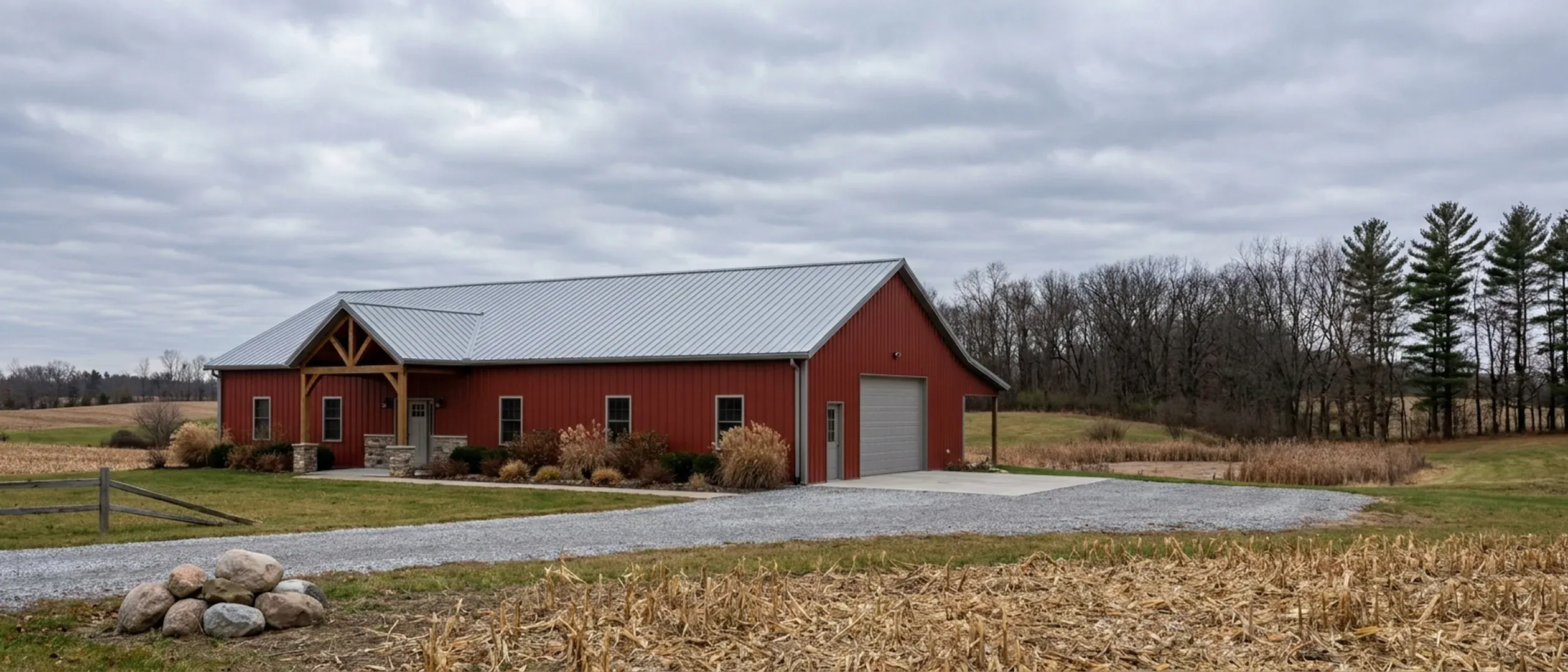
Barndominium Financing in Michigan: Loans, Appraisals and Programs
There is no special barndominium loan. A barndominium you live in is financed like any other new home built on your land: usually with a construction loan that converts to a mortgage when the home is finished. What makes a barndominium harder is not the loan type but the appraisal, because a rural steel or pole barn home may have few comparable sales nearby, and a lender lends against the appraised value, not against what you spent. This guide sets out the rules the big mortgage investor publishes for construction-to-permanent loans and for appraising unusual homes, what Michigan's housing agency and USDA Rural Development offer, how a Farm Credit lender in Michigan handles land loans and owner-built homes, and how much of the cost Midwest owners pay in cash. It is information, not lending advice; a lender decides your loan.
Figures below are industry data from cited third-party sources, not a quote from Michigan Barndominium Builders. Every project is priced individually.
Bottom Line Up Front
- Most barndominiums are financed with a construction-to-permanent loan. Under Fannie Mae's Selling Guide, a single-closing loan can have no single construction period longer than 12 months and no more than 18 months in total, and then converts to a mortgage of up to 30 years.
- The appraisal is the hard part. Fannie Mae allows unique and nontraditional homes when the appraiser has enough information for a reliable value, and lets rural appraisals use older or more distant comparable sales, but a value below your cost to build is cash you bring.
- In Michigan, MSHDA's MI Home Loan can be paired with its MI 10K down payment assistance and its lender terms allow a 180-day commitment for new construction; USDA Rural Development's Section 502 loans can pay to build a modest home in an eligible rural area; and in the Census 2025 data, 31% of contractor-built Midwest homes were paid for in cash.
Published cost figures
Third-party and government figures, each with its source. None of them is a quote, and none of them is ours.
| Measure | Range | Source |
|---|---|---|
| Contract price of contractor-built houses on the owner's land, Midwest region, started in 2025: median to average (land excluded) | $457,200–$546,100per home | U.S. Census Bureau, Characteristics of New Housing 2025, Median and Average Contract Price of New Contractor-Built Single-Family Houses Started: Midwest median $457,200, average $546,100 (read 27 Sep 2026) — https://www.census.gov/construction/chars/xls/contractprice_cust.xls |
| MSHDA MI 10K down payment assistance loan, statewide (maximum) | $10,000per loan | Michigan State Housing Development Authority (MSHDA) MI Home Loan and homeownership pages: MI 10K DPA loan up to $10,000, available statewide, housing education class required; MI Home Loan sales price limit $566,355 after 1 June 2026 (read 27 Sep 2026) — https://www.michigan.gov/mshda/pathway-to-housing/mi-home-loan |
What actually moves the number
The appraised value, not the cost
A lender lends a percentage of the lower of what the home costs and what the appraiser says it will be worth when finished. If a rural barndominium appraises below its cost to build, the difference is cash you bring, whatever your credit and income.
How long the build takes
Under Fannie Mae's rules a single-closing construction loan can run no single period longer than 12 months and no more than 18 months in total. You pay interest on the money drawn during the build, so a slow build costs more, and a build that runs past the limit needs a new approval.
Whether you already own the land
If you own the land, a lender can count it toward the deal: Fannie Mae's rules let a lot owner close a single-closing loan as a limited cash-out refinance that pays off any lien on the lot and funds the build. If you do not, the land is part of the purchase, or you buy it first with a land loan.
Who builds it
Not every lender will fund a borrower acting as their own contractor. Some Michigan lenders do: GreenStone Farm Credit Services says borrowers can use a builder, build it themselves, or a combination of both. Michigan law lets an owner build a home for their own use without a residential builder licence.
Barndominium Loans: What Actually Exists
Lenders do not have a barndominium product. They have construction loans, mortgages and land loans, and a barndominium you live in qualifies for them the same way a house does, if it appraises.
Construction-to-permanent loans
One loan pays for the build in draws and converts to a mortgage when the home is finished. A single-closing loan has one set of closing costs; a two-closing loan has a construction loan and then a separate mortgage. This is the usual route for a barndominium built for you.
Land loans
If you want to buy land now and build later, a land loan comes first. GreenStone Farm Credit Services, for example, lists terms from five to 30 years, down payments from 15%, and no requirement to build within a specific time.
Cash, or cash plus a mortgage later
In the Census 2025 data for contractor-built houses started in the Midwest, 66% were financed conventionally, 2% with FHA insurance, 1% with a VA guarantee, and 31% were paid for in cash. Some owners build with cash or a home-equity loan and take a mortgage once the home is finished and can be appraised.
Kit-only financing
A kit or shell package on its own is building materials, not a home, so it is not what a home mortgage is secured by. Plan to fund a kit purchase from the construction loan's draws or from cash.
Construction-to-Permanent Loans: The Rules Behind Them
Fannie Mae's Selling Guide, which lenders follow for the loans they sell to Fannie Mae, sets these limits for single-closing construction-to-permanent loans. Other loan programs set their own.
12 months per period, 18 months in total
Fannie Mae says the construction period may have no single period of more than 12 months and may not exceed 18 months in total, and after conversion the loan term may not exceed 30 years. Plan a build schedule that fits, including a Michigan winter.
Buying the lot, or already owning it
Under the same rules the loan can close as a purchase, where the construction financing also buys the lot, or as a limited cash-out refinance, where you already hold title to the lot and the loan pays off any lien on it and finances the build.
Your paperwork can go stale
Fannie Mae requires credit documents to be no more than four months old at closing, and income, employment and credit documents no more than four months old again at conversion, with an exception up to 18 months when stated conditions were met at closing. A long build can mean re-documenting your income before the mortgage starts.
Draws and inspections
The money is released in draws as work is done, not all at once. GreenStone Farm Credit Services describes a notarized sworn statement and receipts with each draw request, lien waivers before the next draw, and inspections at the footings, around 50% and 75% completion, and at completion.
The Appraisal: Comparable Sales for a Barndominium
This is where barndominium financing usually gets difficult. The appraiser has to support a value with sales of similar homes, and a rural steel or pole barn home may have few.
Unusual homes are eligible
Fannie Mae's Selling Guide says loans on unique or nontraditional housing are eligible provided the appraiser has adequate information to develop a reliable opinion of market value, and that the comparable sales do not have to be of the same design and appeal.
Rural appraisals can reach further back and further out
The same guide says that where there is a shortage of truly comparable sales the appraiser may use properties further away, and in a rural area with minimal sales activity may use sales older than 12 months, with an explanation.
Large outbuildings raise a residential-or-agricultural question
Fannie Mae says significant outbuildings such as large barns or storage areas may indicate that a property is agricultural in nature, and the lender must decide whether it is residential. A shop under the same roof is part of the home, but a large separate barn or an income-producing operation on the parcel can complicate the loan.
Help the appraiser
Give the appraiser the plans, the specification sheet and the cost breakdown, and point them to any barndominium, pole barn home or custom home sales in the area. A well-documented file does not guarantee a value, but a thin one makes a low value more likely.
Michigan Programs: MSHDA and USDA Rural Development
MSHDA MI Home Loan
A fixed-rate mortgage through participating lenders for first-time buyers statewide and repeat buyers in targeted areas, with income limits, a minimum credit score of 640 and a sales price limit of $566,355 after 1 June 2026, according to MSHDA. MSHDA says its financing works with conventional and FHA loans as well as VA and Rural Development loans, and that a commitment is valid 180 days for new construction.
MSHDA MI 10K down payment assistance
MSHDA lists a MI 10K DPA loan of up to $10,000, available statewide, which MSHDA says can go toward the down payment, closing costs and prepaid expenses. A housing education class is required.
USDA Section 502 direct loans
Under 7 CFR 3550, direct loans may be used to buy, build, rehabilitate, improve or relocate a dwelling. The household's income must be within the low-income limit at approval, the home must be modest for the area and not designed for income-producing purposes, and if the home is being built an adult member of the household must be available to make inspections and authorize progress payments.
USDA Section 502 guaranteed loans
Under 7 CFR 3555, guaranteed loans may be used for the construction or purchase of a new dwelling, including site preparation such as grading, the foundation and the driveway. The site must be in an area USDA designates as rural, typical in size for the area, reached by a hard-surfaced or all-weather road, and served by adequate utilities, water and wastewater. Property used primarily for agriculture or income-producing land is ineligible.
How to Finance a Barndominium in Michigan, Step by Step
1. Get pre-qualified before you buy land
Know what a lender will lend on a finished home before you commit to a parcel. If you are counting on USDA or MSHDA, check the address and your household income against the program rules first.
2. Confirm the land can take a home
Ask the township whether a dwelling is allowed in the zoning district, and the county or district health department whether the site can take a septic system and a well. If the land is enrolled in a PA 116 farmland agreement, a new house generally needs local and state approval (MCL 324.36104). A lender will not fund a home that cannot be permitted.
3. Price the build and the site together
The lender needs the plans, a specification sheet and a cost breakdown that includes the septic system, well, driveway and power, not only the building. See How Much Does It Cost to Build a Barndominium in Michigan?.
4. Plan cash for the gap
Budget for the down payment, closing costs, interest during the build, and the chance that the appraisal comes in below cost. Freddie Mac's survey had the average 30-year fixed rate at 7.03% on 24 September 2026, so interest during a year-long build is a real line.
Reading this because you are weighing a build? The next step is a plan drawn for your program.
What's different about Michigan
MSHDA: the state housing agency's mortgage
The Michigan State Housing Development Authority's MI Home Loan is available to first-time buyers statewide and repeat buyers in targeted areas, through participating lenders. MSHDA lists a minimum credit score of 640, income limits that vary by household size and location, and a sales price limit of $566,355 after 1 June 2026. MSHDA's MI 10K down payment assistance loan is up to $10,000, statewide, with a housing education class. MSHDA's lender page says a loan commitment is valid 90 days for an existing home and 180 days for new construction, so ask a participating lender whether your barndominium plan and schedule fit.
USDA Rural Development in rural Michigan
USDA's Section 502 programs can finance building a home, not only buying one. The direct program (7 CFR 3550) may be used to buy, build, rehabilitate, improve or relocate a dwelling for low-income households, and the guaranteed program (7 CFR 3555) covers the construction or purchase of a new dwelling, including site preparation, in areas USDA designates as rural. Check an address on USDA's eligibility site before you buy land.
Farm Credit lenders and land loans
GreenStone Farm Credit Services, which has locations across Michigan, offers one-time-close home construction loans with an interest-only build period, and home site land loans with terms from five to 30 years and no requirement to build within a set time. Its construction process uses draws backed by a notarized sworn statement and lien waivers, with an appraiser's inspections at the footings, around 50% and 75% completion, and at the end.
Owner-builders
Michigan's Occupational Code does not require a residential builder licence of an owner building a structure on their own property for their own use and occupancy (MCL 339.2403). That exemption covers you as the owner, not the people you pay: anyone who builds a home for you for pay is a residential builder under MCL 339.2401 and needs a licence. Check a builder's licence with LARA before you sign.
Pros and cons, honestly
Pros
- A single-closing construction-to-permanent loan means one approval and one set of closing costs for the build and the mortgage.
- Fannie Mae's rules allow unique homes and let rural appraisals use older and more distant comparable sales.
- MSHDA's down payment assistance is available statewide, and USDA's Section 502 programs can finance building a modest home in eligible rural areas.
- Some Michigan lenders, including a Farm Credit lender, finance land and owner-built homes.
Cons
- The appraisal can come in below the cost to build, and the difference is cash.
- Construction periods are capped, so a slow build can need re-approval.
- USDA excludes income-producing and primarily agricultural property, which matters if the shop is a business.
- A kit on its own is not mortgage collateral; it has to become a finished home first.
Can you get a mortgage on a barndominium in Michigan?
What is a construction-to-permanent loan?
Why do barndominiums sometimes appraise low?
Can I use a USDA loan to build a barndominium in Michigan?
Does MSHDA finance new construction?
Can I be my own general contractor on a construction loan?
Can I finance the land and the barndominium together?
How many people pay cash for a new home?
Questions answered? Tell us what you want to build and we will put real numbers against it.
Sources
- Fannie Mae Selling Guide — B5-3.1-02, Conversion of Construction-to-Permanent Financing: Single-Closing Transactions (05/06/2026) — 12-month single period, 18 months total; 30-year term; purchase or limited cash-out refinance; four-month document age. Read 27 Sep 2026.
- Fannie Mae Selling Guide — B4-1.3-05, Improvements Section of the Appraisal Report (06/04/2025) — Unique and nontraditional housing; significant outbuildings. Read 27 Sep 2026.
- Fannie Mae Selling Guide — B4-1.3-08, Comparable Sales (06/04/2025) — Shortage of truly comparable sales; older sales in rural areas with minimal sales activity. Read 27 Sep 2026.
- Michigan State Housing Development Authority — MI Home Loan — First-time buyers statewide, repeat buyers in targeted areas; credit score 640; sales price limit $566,355 after 1 June 2026; MI 10K DPA up to $10,000. Read 27 Sep 2026.
- Michigan State Housing Development Authority — MI Home Loan Lender Requirements — Commitment valid 90 days for an existing home and 180 days for new construction; works with conventional and FHA loans as well as VA and RD loans. Read 27 Sep 2026.
- eCFR — 7 CFR 3550.52, 3550.53 and 3550.57 (Section 502 direct loans) — Loan purposes, eligibility, dwelling requirements. Read 27 Sep 2026 (version dated 24 Sep 2026).
- eCFR — 7 CFR 3555.101 and 3555.201 (Section 502 guaranteed loans) — Loan purposes including construction and site preparation; rural area and site requirements. Read 27 Sep 2026.
- USDA Income and Property Eligibility Site — Address and income eligibility checks for USDA home loans.
- GreenStone Farm Credit Services — Home Construction Loans — One-time close, interest-only build period, as little as 5% down with PMI, contracted or DIY construction. Read 27 Sep 2026.
- GreenStone Farm Credit Services — Home Site Land Loans — Terms from five to 30 years; as low as 15% down; no requirement to build within a specific timeline. Read 27 Sep 2026.
- GreenStone Farm Credit Services — Understanding the Home Construction Process (20 Jan 2026) — Draws, sworn statement, lien waivers; inspections at footings, about 50%, about 75% and completion. Read 27 Sep 2026.
- U.S. Census Bureau — Contract Price and Type of Financing of New Contractor-Built Single-Family Houses Started (Characteristics of New Housing, 2025) — Midwest 2025: median $457,200, average $546,100; financing conventional 66%, cash 31%, FHA 2% and VA-guaranteed 1%. Read 27 Sep 2026.
- Freddie Mac — Primary Mortgage Market Survey, historical data — 24 Sep 2026: 30-year fixed 7.03%, 15-year fixed 6.42%. Read 27 Sep 2026.
- Michigan Legislature — MCL 339.2403 (residential builder licence exemptions) — Owner of property building a structure for the owner's own use and occupancy.
- Michigan Legislature — MCL 324.36104 (farmland development rights agreements under PA 116)
Keep reading
The pages that answer the next question this one raises.
How Much Does It Cost to Build a Barndominium in Michigan?
The figures a lender's budget review will be checked against.
Read itWhat Size Can Your Budget Build?
Turn a loan amount into a floor area, after the land and site lines.
Read itBarndominium vs House Cost
Which lines a barndominium shell changes, and the appraisal question.
Read itBarndominium Build Timeline
How long the build takes, against a construction loan's time limits.
Read itTurnkey Builds
One contract for the whole home, the way most construction lenders prefer it.
Read itWant a real number instead of a range?
Start the survey and tell us about your land and what you want to build. Include the township and county if you have them, because in Michigan the township zoning, the health department's septic and well answer and the site work change the budget more than the building does. The survey costs nothing.