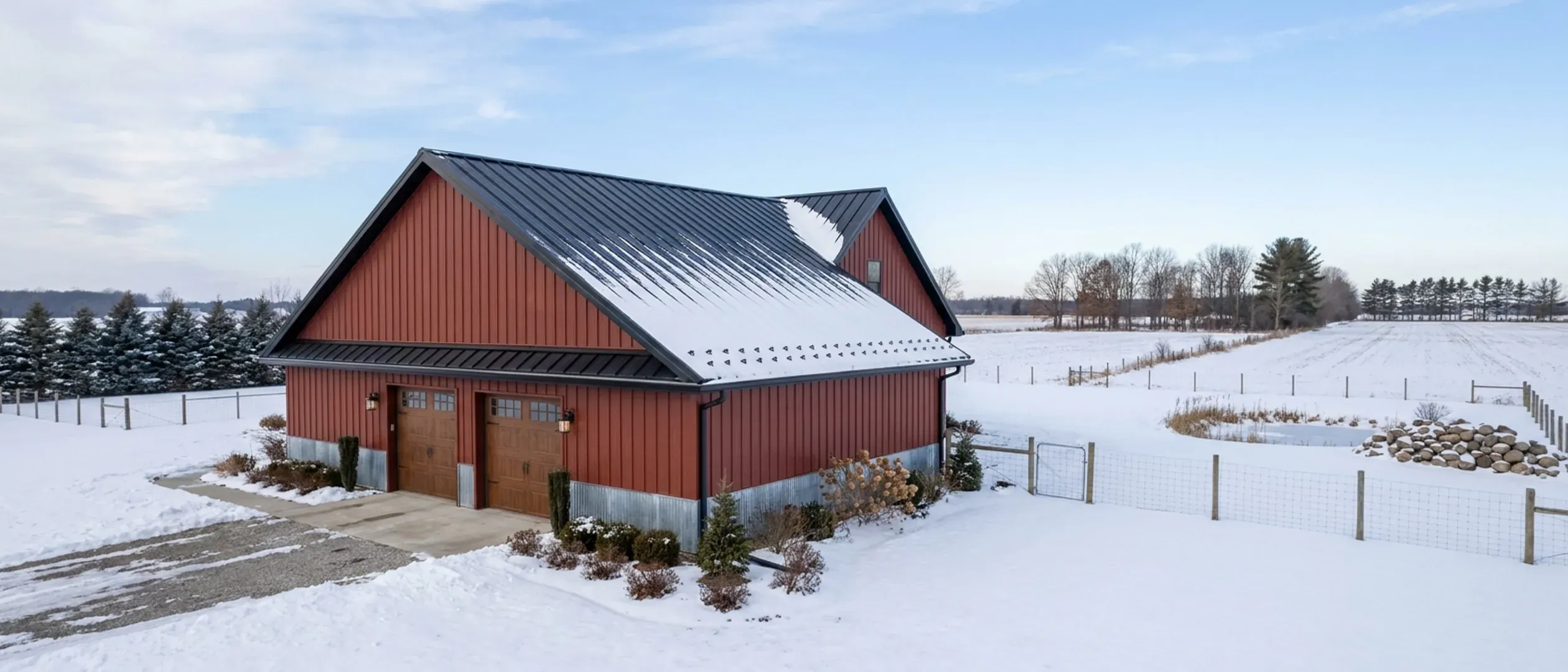
Can You Build a Barndominium in Michigan?
Yes, you can build a barndominium in Michigan. No state law singles barndominiums out. A barndominium with living space is a house, and Michigan applies one construction code everywhere in the state: for homes it is the 2015 Michigan Residential Code, in effect since February 2016. What varies is who enforces it. Your city, village or township may run its own building department; if it does not, the county or the state Bureau of Construction Codes issues the permit, and the Bureau publishes a list showing which one serves each local unit. Around that sit the other layers that decide whether a particular parcel works: local zoning, the septic system and well needed off the sewer and water mains, and the state's permits for earth changes, wetlands, floodplains and shorelines. This page sets out each layer in the order it matters, cites the statute or agency behind every rule, and ends with the questions to ask before you buy land or apply. It is general information, not legal advice for a specific parcel.
Figures on this page are cited third-party or government data, not a quote from Michigan Barndominium Builders.
Bottom Line Up Front
- A barndominium is legal in Michigan as a house. It is built to the statewide Michigan Residential Code, currently the 2015 edition, and a home is not a farm building, so the agricultural-building exemption does not apply to it.
- Zoning decides whether a house can go on the parcel, and in rural Michigan that is usually the township. The building permit comes from the city, village or township if it runs its own program, otherwise the county, otherwise the state Bureau of Construction Codes; the Bureau's Statewide Jurisdiction List shows which.
- Off the sewer, the county or district health department issues the septic permit under its own sanitary code. Earth changes of 1 acre or more, or within 500 feet of a lake or stream, need a soil erosion permit before the building permit, and wetlands, floodplains and critical dunes carry state permits of their own.
- Plans for a one- or two-family home with up to 3,500 square feet of living space do not need an architect's or engineer's seal. Anyone who builds a home for someone else, or sells kit or shell housing, needs a Michigan residential builder licence; owners building for themselves are exempt.
Zoning and farmland
Whether a house can go on a parcel at all is a zoning question, and in rural Michigan it is usually answered by the township.
Township zoning comes first
The Michigan Zoning Enabling Act lets a county, township, city or village zone land (MCL 125.3201 and 125.3102). A township with its own zoning ordinance is not subject to county zoning (MCL 125.3209), and county zoning covers only the townships without one. Zoning may regulate the location, height, bulk, uses and size of dwellings, so minimum house size, setbacks and limits on accessory buildings all come from the local ordinance.
PA 116 farmland agreements
Land enrolled in a farmland development rights agreement under Part 361 carries a restriction: MCL 324.36104 allows a structure only for farm use, including a residence for someone essential to the operation of the farm, or with the approval of the local governing body and the state. Ask the seller whether the land is enrolled before you buy.
Living next to a farm
Michigan's Right to Farm Act says a farm that follows generally accepted agricultural and management practices is not a public or private nuisance, including where the farm existed before a change in the use of land within a mile (MCL 286.473). Building beside an established farm means accepting its normal operations.
Permits, plans and inspections
The building permit is the one approval every barndominium needs.
Apply before construction starts
MCL 125.1510 requires the owner, or the owner's builder, architect, engineer or agent, to apply in writing to the appropriate enforcing agency for a building permit before construction, with complete plans drawn to scale and a site plan. Plumbing and electrical work can carry separate permits.
Find the right office first
Look up your city, village or township in the Bureau of Construction Codes' Statewide Jurisdiction List. It tells you whether the local unit, the county or the state enforces the building code there, and whether the trade permits sit with the same office. The list changes over time, so check it when you apply.
Building without complying is an offence
MCL 125.1523 makes knowingly violating the act or the code a misdemeanour, punishable by a fine of up to $500 or up to 90 days in jail, or both.
Septic, wells and sewer
Off the public mains, the water supply and the wastewater system are part of the house.
Septic: the county or district health department
EGLE describes onsite wastewater management as a required service of local health departments under the Public Health Code, and its guidance says household systems are approved by the local health department under its local sanitary code or the state's subsurface sewage disposal criteria, whichever is more stringent. Local regulations must be at least as stringent as state law (MCL 333.2441). In practice, soil evaluations and system rules vary from one county or district to the next.
Wells: a state code and registered drillers
Wells are built to the Michigan Water Well Construction and Pump Installation Code, and a well drilling contractor must hold a state certificate of registration (MCL 333.12704). The code keeps a well at least 50 feet from a septic tank and a subsurface disposal field, and lets the local health officer vary the distances (R 325.1622). Ask the health department how it reviews a new well for the parcel.
Sewer hook-up can be required
Inside a city, village or township, a building can be required to connect to an available public sanitary sewer if the local unit requires it (MCL 333.12753). Where a sewer runs past the parcel, ask before planning a septic system.
Soil erosion, wetlands, floodplains and shorelines
State environmental permits apply to the land, not the building type, but a rural or waterfront parcel often meets at least one of them.
Soil erosion and sedimentation control (Part 91)
Rule R 323.1704 requires a permit from the enforcing agency before an earth change that disturbs 1 acre or more, or is within 500 feet of the water's edge of a lake or stream, and R 323.1711 says a building permit may not be issued for such work until the erosion permit is in place. The county enforcing agency covers the county except where a municipality has taken the program on (MCL 324.9105). Owners must control erosion even when no permit is needed.
Wetlands (Part 303)
Without an EGLE permit, no one may place fill in, build in or drain a regulated wetland (MCL 324.30304). Regulated wetlands include those connected to the Great Lakes, an inland lake or pond, or a stream, and those larger than 5 acres, among others. Check before you buy land with low or wet areas.
Floodplains
MCL 324.3108 bars occupying land for residential use, or filling or grading it, in a floodplain determined by the state unless the use is permitted under that part.
Critical dunes and Great Lakes shorelands
A use within a mapped critical dune area needs a permit from the local unit of government or the state (MCL 324.35304), and Part 323 regulates designated high-risk areas along the Great Lakes shoreline (MCL 324.32301). Lakeshore buyers should check EGLE's maps for the parcel.
Code details that affect a barndominium
A few design figures in the Michigan Residential Code are set by the state itself.
Footings: 42 inches unless the official adjusts it
Michigan's amendment to the residential code requires exterior footings and foundation systems to extend 42 inches below grade, and lets the building official modify the depth for freezing temperatures, soil type, groundwater, snow depth, exposure or other site conditions (R 408.30522).
Ground snow loads by county
Michigan adds its own table of ground snow loads by jurisdiction to the residential code (R 408.30515). Loads run from 20 pounds per square foot for most of Wayne County to 35 for most of Kent County, 60 for Grand Traverse County and 70 for Marquette County, and many counties list different figures for particular townships or cities. The frame and doors of a barndominium are designed for the figure for the parcel.
Climate zones for the energy chapter
The residential code's energy chapter assigns every county a climate zone: most of the Lower Peninsula is zone 5A, the northern Lower Peninsula and parts of the Upper Peninsula zone 6A, and the coldest Upper Peninsula counties zone 7. The zone sets the insulation requirements the plan reviewer checks.
Kits, modular homes and manufactured homes
Three kinds of factory-made house follow three different approval paths in Michigan.
A barndominium kit is site-built
A steel or pole barn kit, or a panelized package, is assembled on the site. It goes through normal local plan review and inspections like any site-built home, using the manufacturer's engineering for the frame.
A modular home is approved at the factory
Michigan law calls factory-assembled building sections premanufactured units. MCL 125.1519 has the state issue a certificate of acceptability at the place of manufacture; the local enforcing agency then issues the building permit if the rest of the application meets the construction regulations, zoning and local ordinances, and inspects the unit on site for damage in transit and installation. The same section says the certificate may not be used in advertising.
A manufactured home follows the federal code
A manufactured home labelled under the federal manufactured housing construction and safety standards is treated as complying with the state's premanufactured housing standards (MCL 125.1508a). It is a different product from a barndominium kit.
Plans, builders and owner-builders
Who may draw the plans and who may build the house are both set by the Occupational Code.
No architect's seal up to 3,500 square feet of living space
MCL 339.2012 exempts a person planning or designing a detached one- or two-family home of up to 3,500 square feet of calculated floor area, and MCL 339.2014 says plans for such a home submitted without a seal are not a violation. Calculated floor area counts habitable space measured to the outside of the exterior walls and excludes a basement, attic, garage, open porch or storage space, so a shop bay does not count. Above 3,500 square feet of living space, plans need a licensed architect or engineer.
The titles themselves are protected
MCL 339.2014 penalises anyone who uses the title architect, professional engineer or surveyor without the licence. Check the credentials of whoever stamps plans that need a seal.
Building for others takes a residential builder licence
Under MCL 339.2401, a residential builder includes anyone who, for payment, undertakes or offers to build a one- or two-family home for someone else, and anyone who deals in or distributes prefabricated, precut, packaged or shell housing. MCL 339.601 bars unlicensed practice, and MCL 339.2412 bars an unlicensed builder from suing to collect payment or claiming a lien. Before you sign, check the builder's residential builder licence with the state licensing department (LARA).
Owners may build their own home
MCL 339.2403 exempts an owner of property building a structure on it for the owner's own use and occupancy. The house still needs its building permit and inspections, and plumbing, electrical and mechanical work still carry their own permits.
What to ask before you buy or apply
Each of these can be answered before money goes into the land or the design.
Who enforces the building code at this address?
Look the local unit up in the Statewide Jurisdiction List, then ask that office for its permit application requirements.
What does the zoning allow on this parcel?
Ask the zoning office for the district, the minimum house size and lot size, setbacks, and any limits on accessory building size or on metal exteriors, and get the answer in writing.
Is there a sewer, and will the soil take a septic system?
Ask the local unit whether sewer connection is available or required, and the county or district health department what its soil evaluation for a septic permit involves.
Is the land in a farmland agreement, a wetland, a floodplain or a dune area?
Ask the seller about PA 116 enrolment, and check EGLE's resources for wetlands, floodplains, critical dunes and high-risk shorelines before you buy.
How big is the living area?
Keep the habitable floor area in mind when designing: at 3,500 square feet or less, the plans do not need a seal. Garage and shop space do not count toward it.
Is the builder licensed?
If someone else is building the house or selling you the kit, check the residential builder licence with LARA before you sign.
Reading this because you are weighing a build? The next step is a plan drawn for your program.
What's different about Michigan
One construction code for the whole state
The Stille-DeRossett-Hale Single State Construction Code Act says the act and the code "apply throughout the state" (MCL 125.1508a). For one- and two-family homes the code is the Michigan Residential Code. The Bureau of Construction Codes lists the 2015 Michigan Residential Code, based on the 2015 International Residential Code, as the current code, effective February 8, 2016. There is no part of Michigan where a new home is built without a code.
The 2021-based update is on hold
The Bureau of Construction Codes has published a notice that on July 7, 2025, the Michigan Court of Claims issued an order temporarily preventing the state from implementing updated residential and residential energy rules that were due to take effect on August 29, 2025. While that order stands, the Bureau says, the 2015 residential provisions remain valid and in effect. Ask the building department which edition it is reviewing to when you apply.
Who issues the permit is layered
Under MCL 125.1508b, the state is responsible for enforcing the code, and a county, city, village or township may take that responsibility on by ordinance within its boundaries. Where a local unit does not, the county enforces if it has chosen to; where neither does, the state Bureau of Construction Codes enforces directly. So every parcel in Michigan has a code enforcing agency, but it is not always the same kind of office.
The Statewide Jurisdiction List shows who serves your address
The Bureau of Construction Codes publishes a Statewide Jurisdiction List for every city, village and township, marked LOCAL where the unit runs its own program, COUNTY where a county enforcing agency serves it, and STATE where the Bureau does. The Bureau says the list was compiled to help contractors and homeowners secure permits and request inspections. Building, electrical, mechanical and plumbing are listed separately and can be handled by different offices for the same township.
A home is not a farm building
Michigan's construction code act excludes from the definition of a building one that is incidental to the agricultural use of the land and not used for retail trade, and says no building permit is required for such a building (MCL 125.1502a and 125.1510). That exemption is for barns and farm structures. A house is not incidental to farming, so a barndominium, or the living quarters of a shop house, needs a building permit like any other home, even on a working farm.
Pros and cons, honestly
Pros
- One construction code applies everywhere in Michigan, so the rules for a home are the same in every county.
- Every parcel has a code enforcing agency, and the state publishes which one serves each local unit.
- Plans for a home with up to 3,500 square feet of living space do not need an architect's or engineer's seal.
- Owners may build their own home without a builder's licence.
- A barndominium is treated as a house, so it can be permitted, financed and insured as one.
Cons
- Who issues the permit varies by township, and trade permits can sit with a different office.
- The farm-building exemption does not cover a home, even on a working farm.
- Zoning rules on house size and accessory buildings vary from one township to the next.
- Septic rules are set by each county or district health department.
- Wetlands, floodplains, dunes and earth changes near water carry state permits of their own.
Are barndominiums legal in Michigan?
Can you build a barndominium in Michigan?
What building code applies to a barndominium in Michigan?
Who issues building permits in Michigan?
Is a barndominium exempt as an agricultural building?
Can I build a barndominium on farmland in Michigan?
Can I live in my pole barn in Michigan?
Do I need a septic permit in Michigan?
Do I need a soil erosion permit to build?
Who controls zoning for rural land in Michigan?
Do I need an architect to design a barndominium in Michigan?
Is a barndominium kit the same as a modular home?
Can I build my own barndominium in Michigan?
Does the person selling me a kit need a licence?
Questions answered? Tell us what you want to build and we will put real numbers against it.
Sources
- Michigan Compiled Laws — MCL 125.1501 (Stille-DeRossett-Hale single state construction code act)
- Michigan Compiled Laws — MCL 125.1508a (code applies throughout the state; premanufactured housing)
- Michigan Compiled Laws — MCL 125.1508b (who administers and enforces the code)
- Michigan Compiled Laws — MCL 125.1502a (definitions, including the agricultural building exclusion)
- Michigan Compiled Laws — MCL 125.1510 (building permit application)
- Michigan Compiled Laws — MCL 125.1519 (premanufactured units, certificate of acceptability)
- Michigan Compiled Laws — MCL 125.1523 (violations)
- LARA Bureau of Construction Codes — Code Books (current code editions)
- LARA Bureau of Construction Codes — 2021 residential code notification (Court of Claims order)
- LARA Bureau of Construction Codes — Statewide Jurisdiction List
- LARA Bureau of Construction Codes (licence verification)
- Michigan Compiled Laws — MCL 339.2012 (architect and engineer exemptions)
- Michigan Compiled Laws — MCL 339.2014 (protected titles; unsealed residential plans)
- Michigan Compiled Laws — MCL 339.2401 (residential builder definitions)
- Michigan Compiled Laws — MCL 339.2403 (exemptions, including owners)
- Michigan Compiled Laws — MCL 339.2412 (unlicensed builders: no collection action or lien)
- Michigan Compiled Laws — MCL 339.601 (practice without a licence)
- Michigan Compiled Laws — MCL 125.3201 (Michigan Zoning Enabling Act: zoning ordinances)
- Michigan Compiled Laws — MCL 125.3102 (Zoning Enabling Act definitions)
- Michigan Compiled Laws — MCL 125.3209 (township zoning and county ordinances)
- Michigan Compiled Laws — MCL 324.36104 (PA 116 farmland development rights agreements)
- Michigan Compiled Laws — MCL 286.473 (Michigan Right to Farm Act)
- Michigan Department of Environment, Great Lakes, and Energy (EGLE) — Onsite wastewater management
- Michigan Compiled Laws — MCL 333.2441 (local health department regulations)
- Michigan Compiled Laws — MCL 333.12704 (well drilling contractor registration)
- Michigan Administrative Code — R 325.1601 to R 325.1781 (water well construction code; R 325.1622 isolation distances)
- Michigan Compiled Laws — MCL 333.12753 (connection to public sanitary sewer)
- Michigan Administrative Code — R 323.1701 to R 323.1714 (Part 91 soil erosion and sedimentation control rules)
- Michigan Compiled Laws — MCL 324.9105 (soil erosion: county enforcing agency)
- Michigan Compiled Laws — MCL 324.30304 (wetland permits)
- Michigan Compiled Laws — MCL 324.3108 (floodplain occupation and filling)
- Michigan Compiled Laws — MCL 324.35304 (critical dune area permits)
- Michigan Compiled Laws — MCL 324.32301 (Great Lakes shorelands: high-risk areas)
- Michigan Administrative Code — R 408.30500 to R 408.30547g (Michigan Residential Code amendments: snow loads, footing depth, climate zones)
Keep reading
The pages that answer the next question this one raises.
Permitting
How the permit process works in practice.
Read itHow long does it take to build a barndominium?
Where the approvals fall in the schedule.
Read itBarndominium kits
Kits, panelized packages and how they differ from modular homes.
Read itCustom plans
Designing a floor plan for your site.
Read itBarndominium pros and cons in Michigan
Snow, cold, condensation and appraisal.
Read itStart the survey
Tell us about your land and what you want to build.
Read itWant a real number instead of a range?
Start the survey and tell us about your land and what you want to build. Include the township and county if you have them, because in Michigan the township zoning, the health department's septic and well answer and the site work change the budget more than the building does. The survey costs nothing.