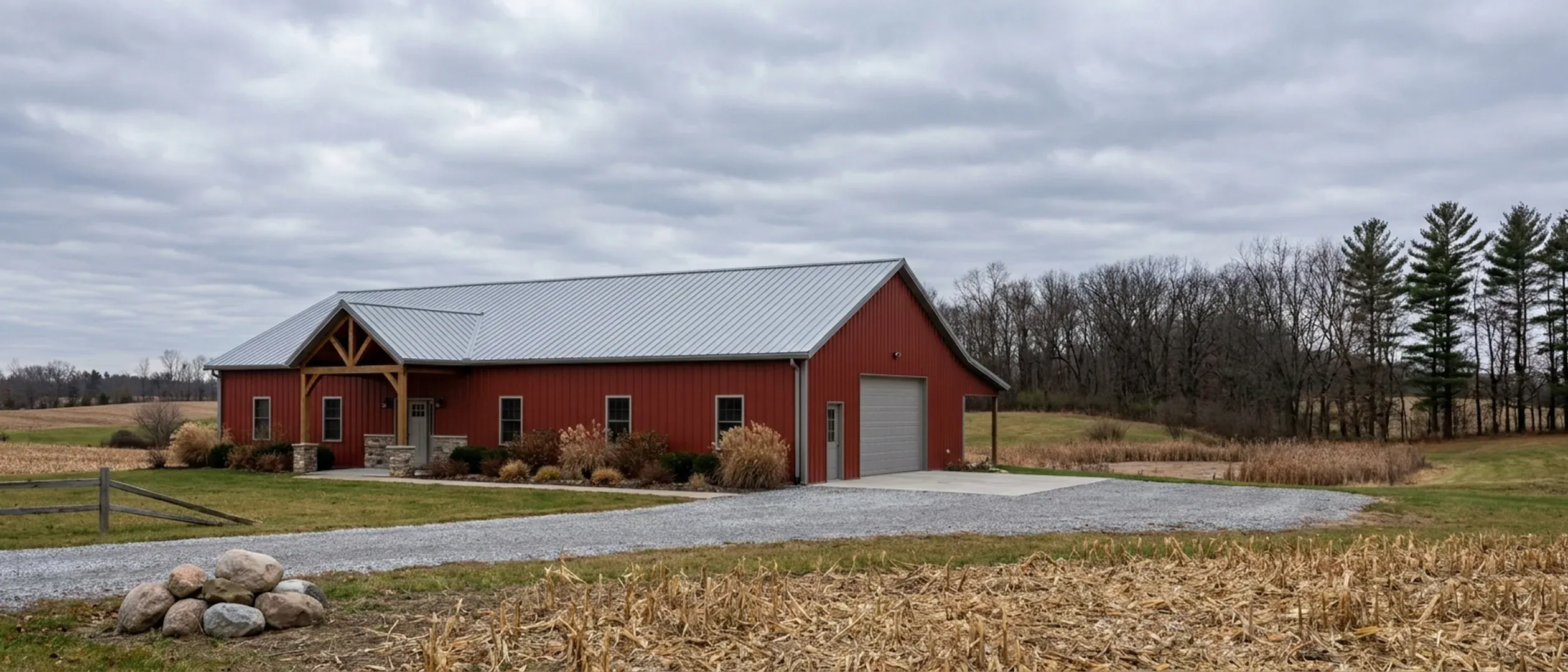
What Size Barndominium Can Your Budget Build in Michigan?
The question most people start with is how big a barndominium their budget will build. The honest method has two steps. First, take off everything that is not the building: the land, and on rural Michigan land the septic system, the well, the driveway and the power run. Then divide what is left by a published cost per square foot. The closest published figure for a home built by a contractor on the owner's land in the Midwest is the Census Bureau's 2025 contract price, $194.09 median and $202.13 average per square foot with land excluded. This guide works through budgets from $100,000 to $500,000 on that basis, covers small barndominiums and shop space, and shows the Michigan lines that come off the top. None of it is our pricing, and none of it is a quote.
Figures below are industry data from cited third-party sources, not a quote from Michigan Barndominium Builders. Every project is priced individually.
Bottom Line Up Front
- On the Census 2025 Midwest contract price of $194.09 to $202.13 per square foot, land excluded, $100,000 builds roughly 495 to 515 square feet of finished home, $200,000 roughly 990 to 1,030, and $300,000 roughly 1,480 to 1,550.
- Take the site off the top first. On raw rural land in Michigan that means the septic system and well, permitted by the county or district health department, plus the driveway, power and any clearing. Those lines do not shrink with a smaller house.
- Shop space changes the arithmetic. Unheated shop or garage space costs far less per square foot than living space, so a small living area with a large shop can fit a budget that a large all-living plan cannot, and in Michigan a shop does not count toward the 3,500 sq ft living-area line for an architect's seal.
Published cost figures
Third-party and government figures, each with its source. None of them is a quote, and none of them is ours.
| Measure | Range | Source |
|---|---|---|
| Contractor-built houses on the owner's land, Midwest region, started in 2025: median to average contract price (land excluded) | $194–$202per sq ft | U.S. Census Bureau, Characteristics of New Housing 2025, Median and Average Contract Price per Square Foot of New Contractor-Built Single-Family Houses Started: Midwest median $194.09, average $202.13 (read 27 Sep 2026) — https://www.census.gov/construction/chars/xls/contractpricesqft_cust.xls |
| The same measure for the whole United States, 2025: median to average contract price (land excluded) | $172–$198per sq ft | U.S. Census Bureau, Characteristics of New Housing 2025, Median and Average Contract Price per Square Foot of New Contractor-Built Single-Family Houses Started: United States median $171.57, average $198.33 (read 27 Sep 2026) — https://www.census.gov/construction/chars/xls/contractpricesqft_cust.xls |
| Michigan agricultural land, 2026 state average: pasture to cropland | $3,200–$6,600per acre | USDA NASS, Land Values 2026 Summary (released 31 July 2026): Michigan pasture $3,200, cropland $6,600 per acre (read 27 Sep 2026) — https://www.nass.usda.gov/Publications/Todays_Reports/reports/land0726.pdf |
Total cost by size
Rough totals at common sizes. These move with everything on this page, so treat them as a starting orientation, not an estimate for your project.
800 sq ft
$155,000–$162,000
Arithmetic, rounded to the nearest $1,000: 800 sq ft × the Census 2025 Midwest contract price per sq ft for contractor-built houses ($194.09 median, $202.13 average), land excluded — https://www.census.gov/construction/chars/xls/contractpricesqft_cust.xls
1,000 sq ft
$194,000–$202,000
Arithmetic, rounded to the nearest $1,000: 1,000 sq ft × the Census 2025 Midwest contract price per sq ft for contractor-built houses ($194.09 median, $202.13 average), land excluded — https://www.census.gov/construction/chars/xls/contractpricesqft_cust.xls
1,500 sq ft
$291,000–$303,000
Arithmetic, rounded to the nearest $1,000: 1,500 sq ft × the Census 2025 Midwest contract price per sq ft for contractor-built houses ($194.09 median, $202.13 average), land excluded — https://www.census.gov/construction/chars/xls/contractpricesqft_cust.xls
2,000 sq ft
$388,000–$404,000
Arithmetic, rounded to the nearest $1,000: 2,000 sq ft × the Census 2025 Midwest contract price per sq ft for contractor-built houses ($194.09 median, $202.13 average), land excluded — https://www.census.gov/construction/chars/xls/contractpricesqft_cust.xls
2,500 sq ft
$485,000–$505,000
Arithmetic, rounded to the nearest $1,000: 2,500 sq ft × the Census 2025 Midwest contract price per sq ft for contractor-built houses ($194.09 median, $202.13 average), land excluded — https://www.census.gov/construction/chars/xls/contractpricesqft_cust.xls
What actually moves the number
Land first
USDA's 2026 survey puts Michigan cropland at $6,600 an acre and pasture at $3,200 on average. A home site split from a farm, wooded land or lake frontage usually costs more per acre than those farm averages, so price the parcel you want before you size the house.
Septic and well do not shrink
A two-bedroom home and a four-bedroom home both need a septic system and a well on rural land. In Michigan the county or district health department permits the septic system under its own sanitary code. Each county or district health department sets its own permit fees, so ask yours for its current fee schedule. The installed systems cost far more than the permits.
Kitchens and bathrooms are fixed costs
A small home still needs a kitchen, at least one bathroom, a water heater, a furnace or heat pump and an electrical service. Those items do not get cheaper in proportion to the floor area, which is why small homes usually cost more per square foot than large ones on the same finish level.
Shop space is cheaper space
Unheated or lightly finished shop and garage space costs far less per square foot than living space. If your budget will not stretch to the floor area you want, keep the living area modest and give the rest of the building to shop and storage.
How Big a Barndominium Can You Build for $100,000, $200,000 or $300,000?
Each figure below divides the building budget, after land and site work, by the Census 2025 Midwest contract price for contractor-built homes: $194.09 median and $202.13 average per square foot, land excluded. The larger number uses the median.
$100,000: about 495 to 515 square feet
On the Census Midwest figures, $100,000 covers about 495 to 515 square feet of finished home. That is a studio or one-bedroom plan. At this budget most people are pricing a shell to finish themselves, or a small apartment inside a larger shop.
$150,000: about 740 to 775 square feet
On the same Census figures, $150,000 builds about 740 to 775 square feet: a compact one-bedroom, or a small two-bedroom with a tight plan.
$200,000: about 990 to 1,030 square feet
$200,000 at the Census Midwest rate covers about 990 to 1,030 square feet, a two-bedroom home with one bathroom or a small two-bath plan. See the small barndominium floor plan.
$300,000: about 1,480 to 1,550 square feet
$300,000 at the Census Midwest rate covers about 1,480 to 1,550 square feet, about the size of a modest three-bedroom single-storey plan.
$400,000: about 1,980 to 2,060 square feet
$400,000 at the Census Midwest rate covers about 1,980 to 2,060 square feet. For comparison, the median contractor-built house completed in the Midwest in 2025 had 2,289 square feet, per the Census.
$500,000: about 2,470 to 2,580 square feet
$500,000 at the Census Midwest rate covers about 2,470 to 2,580 square feet, a four-bedroom plan or a three-bedroom plan with generous living space.
Small Barndominiums
A small barndominium is usually a one- or two-bedroom home of roughly 800 to 1,500 square feet, often with a shop or garage under the same roof. Here is what small does and does not save.
Small is well below the local norm
The median contractor-built house completed in the Midwest in 2025 had 2,289 square feet and the average 2,471, per the Census. A 1,000 sq ft barndominium is less than half the median, which is the main way a small plan fits a small budget.
The cost per square foot goes up as the home gets smaller
The kitchen, the bathroom, the mechanical systems, the septic system and the well are needed at any size, so they are a larger share of a small home's budget. Expect a small barndominium to cost more per square foot than the Census average, even though it costs less in total.
Small living area, big shop
The most common small barndominium is a modest living area inside a larger building with a shop, garage or equipment bay. The shop part costs far less per square foot than the living part. See the barndominium with shop plan and the 30x40 barndominium plan.
Check the township before you go very small
Michigan's Zoning Enabling Act lets a zoning ordinance regulate the size of dwellings (MCL 125.3201), and in rural Michigan the zoning ordinance is usually the township's; county zoning applies only where the township has none. Read the ordinance for any minimum dwelling size and for limits on accessory buildings before you commit to a very small home or a very large shop.
Take the Land and Site Work Off the Top First
The per-square-foot figures above exclude the land. On rural Michigan land, the site lines can be a large share of a small budget.
The land
USDA's 2026 survey puts Michigan cropland at $6,600 an acre and pasture at $3,200 on average; farm real estate including buildings averages $7,000. Home sites, woods and water frontage usually cost more per acre than those farm averages.
Septic system and well
In Michigan, septic permits for a home are issued by the county or district health department under its own sanitary code. Each county or district health department sets its own permit fees, so ask yours for its current fee schedule. The installed systems cost far more than the permits. Wells are drilled by state-registered well drilling contractors.
Driveway, power and clearing
NAHB's builder survey puts the driveway at 2.3% of an average home's construction cost on a typical lot. A home set well back from the road, with a new power line and trees to clear, can need much more. Get the utility's line-extension quote before you buy the land.
Soil erosion permit on bigger earth moves
An earth change that disturbs 1 or more acres, or that is within 500 feet of a lake or stream, needs a Part 91 soil erosion permit from the county or municipal enforcing agency before work starts, and the building permit cannot be issued until that permit has been (R 323.1704 and R 323.1711). The fee and the silt fence or seeding it requires belong in the site-work budget. See Site Preparation.
What Does a 1,500, 2,000 or 2,500 sq ft Barndominium Cost?
Working the other way, from floor area to budget, on the same Census 2025 Midwest contract price, land excluded. The full cost breakdown is in How Much Does It Cost to Build a Barndominium in Michigan?.
1,500 sq ft: about $291,000 to $303,000
1,500 square feet at the Census Midwest rate of $194.09 to $202.13 per square foot, before land, septic and well.
2,000 sq ft: about $388,000 to $404,000
2,000 square feet at the Census Midwest rate, before land and site work. On the Census national figures of $171.57 to $198.33 the same home works out to about $343,000 to $397,000.
2,500 sq ft: about $485,000 to $505,000
2,500 square feet at the Census Midwest rate, before land and site work. If part of that floor area is shop or garage, price the two parts separately.
Reading this because you are weighing a build? The next step is a plan drawn for your program.
What's different about Michigan
The 3,500 sq ft line counts living space only
Under MCL 339.2012, plans for a one- or two-family home with up to 3,500 square feet of living space do not need an architect's or engineer's seal. Garages, basements, attics, open porches and storage space do not count toward that figure, so a large shop bay under the same roof does not push a home over the line. Above it, budget for a licensed architect or engineer.
A small home is still a house under the code
Michigan applies one construction code everywhere, and for homes it is the 2015 Michigan Residential Code. A small barndominium goes through the same plan review and inspections as a large one, and the permit comes from your city, village or township, or the county or the state Bureau of Construction Codes where the township does not enforce the code itself.
Township zoning decides what size is allowed
Zoning in Michigan may regulate the location, height, bulk, uses and size of dwellings (MCL 125.3201), and in rural areas the zoning ordinance is usually the township's; county zoning applies only where the township has no ordinance of its own. It decides whether a home is allowed on the parcel, how far it must sit from the lines and the road, and whether a minimum floor area applies. Read it for your zoning district before you settle on a very small plan or a very large accessory shop.
Pros and cons, honestly
Pros
- Dividing a budget by a published cost per square foot gives a floor area you can test against a real plan.
- Shop and storage space under the same roof costs far less per square foot than living space.
- Plans for up to 3,500 square feet of living space need no architect's seal in Michigan, and a shop bay does not count toward the line.
- A small plan is the most direct way to fit a small budget.
Cons
- Small homes cost more per square foot, because the kitchen, bathroom, mechanicals, septic and well are needed at any size.
- On raw rural land the site lines come off the top and can take a large share of a small budget.
- The Census figures are regional house benchmarks, not measured barndominium prices.
- Township zoning may limit very small dwellings or very large accessory buildings.
How big a barndominium can I build for $200,000 in Michigan?
Can you build a barndominium for $100,000?
How big a barndominium can I build for $300,000?
How much does a small barndominium cost in Michigan?
What does a 2,000 sq ft barndominium cost?
Does the shop count toward the square footage?
Is there a minimum size for a house in Michigan?
Questions answered? Tell us what you want to build and we will put real numbers against it.
Sources
- U.S. Census Bureau — Median and Average Contract Price per Square Foot of New Contractor-Built Single-Family Houses Started (Characteristics of New Housing, 2025) — Midwest 2025: median $194.09, average $202.13; United States: median $171.57, average $198.33 per sq ft, lot excluded. Read 27 Sep 2026.
- U.S. Census Bureau — Square Feet of Floor Area in New Single-Family Houses Completed: Contractor-Built (Characteristics of New Housing, 2025) — Midwest 2025: median 2,289, average 2,471 sq ft. Read 27 Sep 2026.
- USDA National Agricultural Statistics Service — Land Values 2026 Summary — Michigan 2026: farm real estate $7,000, cropland $6,600, pasture $3,200 per acre. Read 27 Sep 2026.
- NAHB — Cost of Constructing a Home 2024 (Special Study, January 2025) — Driveway 2.3% of construction cost. National averages. Read 27 Sep 2026.
- Genesee County Health Department — Septic: GCHD Environmental Health Program — Perc test required before a septic permit, valid 5 years; the department publishes its own fees. Read 27 Sep 2026.
- Saginaw County Health Department — Environmental Health Services Fee Schedule — The department's own published septic and well permit fees. Read 27 Sep 2026.
- Michigan Legislature — MCL 339.2012 (architect and engineer licensing exemptions) — Detached one- and two-family residence up to 3,500 sq ft of calculated floor area; garage, basement, attic, open porch and storage excluded.
- LARA Bureau of Construction Codes — Code Books — 2015 Michigan Residential Code, current code, effective 8 Feb 2016.
- LARA Bureau of Construction Codes — Statewide Jurisdiction List — Which unit of government enforces the building code in each township, city and village.
- Michigan Administrative Code — R 323.1701 to R 323.1714 (Part 91 soil erosion and sedimentation control) — R 323.1704: permit for an earth change of 1 or more acres or within 500 feet of a lake or stream; R 323.1711: no building permit until the soil erosion permit issues. Read 27 Sep 2026.
- Michigan Legislature — MCL 125.3201 (Michigan Zoning Enabling Act: zoning ordinances)
- EGLE — Onsite Wastewater Management — Local health departments permit onsite sewage systems for homes under the local sanitary code.
Keep reading
The pages that answer the next question this one raises.
How Much Does It Cost to Build a Barndominium in Michigan?
Census cost per square foot, Michigan permit values by region, land, septic and well.
Read itSmall Barndominium Floor Plan
A compact plan for a small budget.
Read it30x40 Barndominium Floor Plan
A 1,200 sq ft footprint, laid out for living or split with a shop.
Read itBarndominium with Shop
Living space and a shop under one roof.
Read itBarndominium Financing in Michigan
How the loan and the appraisal shape the budget you can actually spend.
Read itWant a real number instead of a range?
Start the survey and tell us about your land and what you want to build. Include the township and county if you have them, because in Michigan the township zoning, the health department's septic and well answer and the site work change the budget more than the building does. The survey costs nothing.